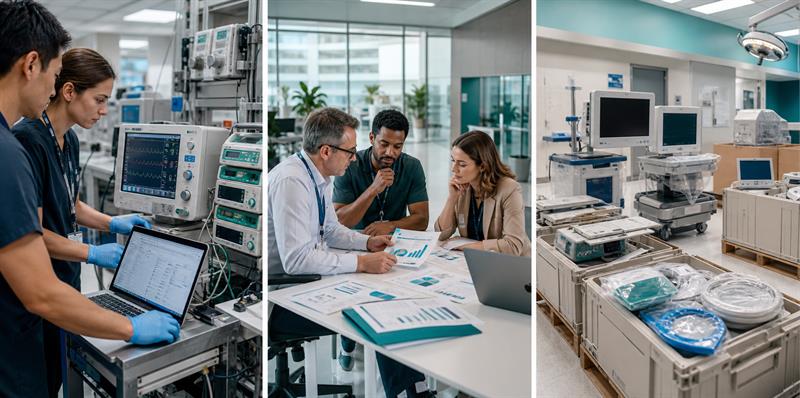
Hospital Equipment Replacement Planning 2026: Repair or Replace Checklist
Hospital Equipment Replacement Planning 2026: Repair or Replace Checklist
Hospitals rarely lose money because a device is old. They lose money because replacement decisions are made too late, too early, or without a consistent framework. In 2026, procurement teams and biomedical departments need a practical method to decide whether a device should be repaired, upgraded, or fully replaced. This article outlines a simple decision model that supports budget planning, uptime, and clinical safety.
Contents
- Why replacement planning matters in 2026
- How to decide repair, upgrade, or rebuy
- Replacement signals hospitals should track
- How procurement and biomedical teams should work together
- Replacement planning checklist
- Common mistakes in replacement decisions
Why replacement planning matters in 2026
Hospital fleets are under pressure from heavier workloads, tighter compliance expectations, and rising service costs. That means the real question is no longer whether a device still powers on. The question is whether it can deliver reliable clinical performance without creating hidden maintenance burden, delayed treatment, or supplier dependence.
For hospitals buying from China, replacement planning should be connected to the original sourcing and service strategy. China Care Medical's company page, the article on equipment maintenance contract considerations, and the guide on installation planning all point to the same principle: lifecycle decisions should be made before equipment failure turns into a clinical disruption.

How to decide repair, upgrade, or rebuy
A practical replacement model starts with three questions:
- Repair: Is the fault isolated, affordable, and unlikely to repeat after service?
- Upgrade: Can the equipment regain acceptable performance through software, accessories, modules, or targeted refurbishment?
- Rebuy: Has the asset become too expensive, too unreliable, or too limited for current clinical demand?
If a device still meets clinical need, has stable parts availability, and can be restored cost-effectively, repair is usually the right choice. If the core platform remains sound but the configuration is outdated, an upgrade may extend useful life. If recurring downtime, spare-parts risk, and compliance exposure are all rising together, rebuying is often cheaper over the next three to five years.
Replacement signals hospitals should track
- Repeated breakdowns within the same 12-month period
- Escalating repair invoices compared with residual equipment value
- Long supplier lead times for boards, sensors, batteries, or accessories
- User complaints about workflow inefficiency, alarms, or unstable performance
- Electrical safety, calibration, or regulatory documentation gaps
- Clinical demand that now exceeds the device's throughput or features
These signals should be logged centrally, not stored in separate engineering notebooks or department emails. Without that visibility, hospitals end up paying premium rates for emergency fixes instead of planning orderly replacements.
How procurement and biomedical teams should work together
Replacement planning should not sit entirely with procurement or entirely with engineering. Biomedical teams provide failure history, service trend data, and practical user feedback. Procurement teams translate that information into budget timing, supplier comparison, and contract strategy. When both sides work from the same asset register, hospitals can sequence replacements without creating sudden capex spikes.
Parts planning also matters here. Our related article on medical equipment spare parts planning explains why some devices should stay in service with improved inventory support, while others clearly need full replacement.

Replacement planning checklist
- Maintain one asset register with install date, department, service history, and warranty status.
- Review total repair cost over the last 12 to 24 months for each critical asset.
- Check current parts availability and realistic supplier lead times.
- Document whether software, modules, or refurbishment can solve the performance gap.
- Compare projected repair cost with the cost of replacement over a three-year window.
- Prioritize replacement for devices with both clinical criticality and recurring downtime.
- Schedule site readiness, training, and installation support before delivery.
- Use replacement decisions to negotiate stronger after-sales terms on the new purchase.
Common mistakes in replacement decisions
The biggest planning errors are delaying replacement until the asset fails during peak workload, replacing equipment without checking whether an upgrade would have solved the issue, and making rebuy decisions based only on purchase price. The correct comparison is lifecycle cost, not sticker cost.
Final recommendation: build a quarterly replacement review that ranks equipment by failure frequency, service cost, parts risk, and clinical importance. That is the fastest way to move from reactive spending to controlled capital planning.